NCAA D1 Student-Athlete
Trained and competed year-round as a Division I student-athlete, balancing high-level competition with a demanding academic schedule. Learned to prioritize effectively, remain composed under pressure, and maintain a strong work ethic while collaborating with teammates and coaches to pursue continuous improvement.
Physics & Math Tutor
Led weekly mathematics and physics review sessions for groups of 5–10 students, translating complex technical concepts into clear, accessible explanations and guiding students through challenging problem-solving exercises. Fostered an engaging and collaborative learning environment that strengthened conceptual understanding, analytical reasoning, and exam preparedness while adapting instruction to individual learning styles.
International Student Advisor
Guided groups of 10–20 incoming international students through the university onboarding process, providing comprehensive support on visas, health insurance, tax requirements, housing, and campus resources. Helped students successfully transition to university life by answering questions, connecting them with relevant services, and fostering an inclusive and welcoming environment.
Winner of the Scholar Athlete of the Year Award (2025)
Recognized as the scholar-athlete with the highest GPA on the team (3.98).
Conference Champion – Distance Medley Relay
Won the conference gold medal as part of the Distance Medley Relay team.
Bronze Medal – European Championship
In my main discipline - 400m Hurdles.
6-DOF Inertia Measuring Device - Swinging Platform

Developed a low-cost, portable prototype for Dynisma to measure a vehicle or chassis’s mass, three-axis centre of gravity (CoG), and three-axis moments of inertia (MoI) for payloads ranging from 50–1000 kg. The project addressed the limitations of CAD-based estimates and expensive third-party testing by investigating the feasibility of an in-house measurement system. Alongside market research and competitor analysis, technical requirements were established, targeting high measurement accuracy, portability, and seamless integration with Dynisma’s existing hardware and software ecosystem.
Designed and built a suspended measurement platform using an A-frame, three load cells, IMUs, a Teensy 4.1 microcontroller, and Bluetooth-enabled real-time data acquisition. The system combined static and dynamic testing to calculate mass, CoG, and MoI through sensor fusion and mathematical modelling, with signal processing and calibration performed in Python. Significant engineering effort focused on improving sensor accuracy, filtering noise, reducing mechanical friction, and minimising structural effects that could influence measurement reliability.
Constructed a functional prototype for approximately $1,200, successfully achieving the target mass accuracy (±1 kg) while demonstrating promising CoG measurement performance. The project validated the feasibility of an affordable in-house solution, although MoI measurements—particularly about the vertical axis—highlighted areas requiring further refinement. The work concluded with recommendations for improved mechanical design, enhanced sensing and calibration methods, and scalable architecture to support future development towards a production-ready system.
Offshore Structural Dynamics Research

My graduate research focuses on the application of stochastic methods to offshore structural dynamics, investigating how offshore platforms and marine structures respond to uncertain environmental loading from waves, wind, and ocean currents. The research explores probabilistic wave modeling using Pierson–Moskowitz and JONSWAP spectra, random wave simulations, and dynamic response analysis of tension leg platforms (TLPs), marine risers, and Spar structures. Particular emphasis is placed on understanding structural motion, fatigue, extreme loading conditions, and reliability through analytical modeling and numerical simulation.
A central area of investigation involves nonlinear wave–structure interactions, particularly how calculating wave forces at a platform's instantaneous displaced position can produce significant mean horizontal offsets that conventional linear models may overlook. Building on research by Professor Pol Spanos, this work examines opportunities to combine stochastic simulation, nonlinear dynamics, and equivalent statistical linearization to improve predictions of platform motion, geometric set-down, and extreme-response probabilities. The broader objective is to develop computationally efficient approaches for evaluating offshore structural performance and reliability under realistic, irregular ocean conditions.
3-DOF Robot Arm Control
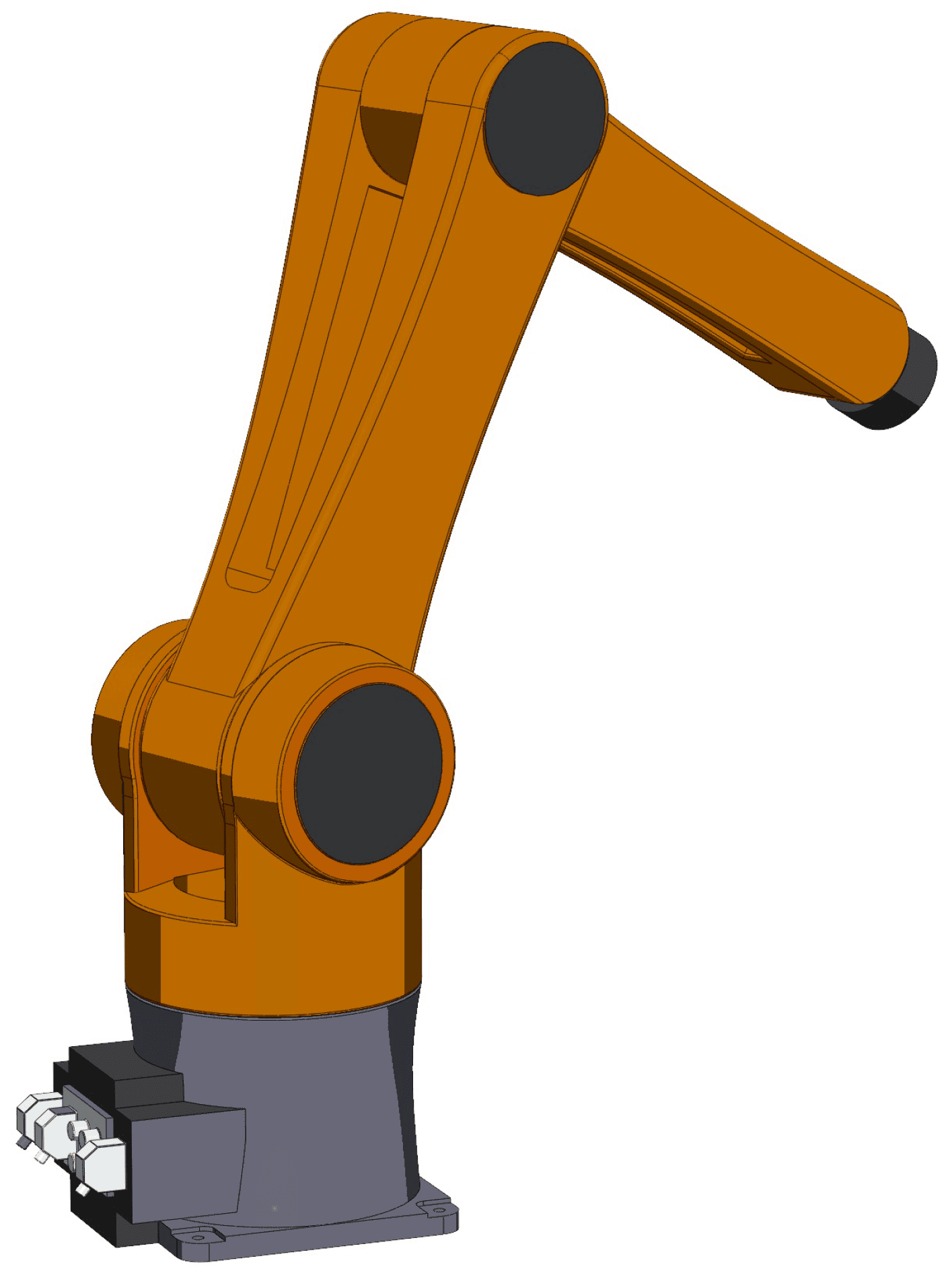
Developed a comprehensive mathematical and computational model of a three-degree-of-freedom (3-DOF) robotic manipulator, focusing on its kinematics, dynamics, and motion control. Derived the forward kinematics, link velocities and accelerations, and nonlinear equations of motion using analytical mechanics, accounting for mass properties, inertia, gravity, and joint damping. Implemented numerical simulations to evaluate the robot's uncontrolled dynamic response, analyzing joint positions, velocities, and energy evolution over time.
Extended the model to an industrial bin-sorting application by developing a linear state-space control framework for precise robotic positioning. Analyzed system stability, controllability, and observability, and designed a state-feedback controller with a state observer to estimate unmeasured joint velocities. Evaluated closed-loop performance by comparing linear predictions against the full nonlinear robotic model under varying initial position disturbances, velocity perturbations, and observer estimation errors. Investigated the controller's region of validity and stability limits, incorporating Lyapunov-based stability analysis to assess the manipulator's robustness beyond its nominal operating conditions.
Analog and Digital Control - Inverted pendulum

Designed, implemented, and validated both analog and digital state-feedback controllers to stabilize an inverted pendulum while meeting strict control performance specifications (ζ = 0.707, 2% settling time of 0.5 s). The project involved deriving controller gains through analytical modeling, designing signal conditioning circuits (position scaling and practical differentiators), implementing feedback control using operational amplifiers and embedded software, and experimentally tuning the system to achieve stable, repeatable balancing. Performance was verified through oscilloscope measurements, system response plots, and experimental testing.
For the digital implementation, developed controllers operating at 100 Hz and 1000 Hz using both potentiometer- and encoder-based feedback, evaluating the effects of sampling rate and sensor selection on stability, overshoot, and settling time. Experimental tuning refined theoretical gains to account for real-world system behavior, achieving responses within a few percent of the target specifications. The project demonstrates practical experience in classical control systems, embedded programming, analog circuit design, state-feedback control, signal processing, system identification, and hardware–software integration.
Interactive Whack-A-Mole Style Game

Designed and built an interactive Whack-A-Mole game to demonstrate the integration of sensing, actuation, embedded programming, and mechanical design within a responsive mechatronic system. The project features a custom tabletop board with illuminated push buttons controlled by a central microcontroller, which randomly activates targets, processes player input in real time, tracks scores, and provides immediate visual and audio feedback. The system was engineered for reliability, fast response times, and an intuitive user experience suitable for live demonstrations.
The project involved the complete development lifecycle, including hardware selection, circuit integration, embedded software development, mechanical enclosure design, prototyping, testing, and final system integration. A custom enclosure was designed to securely house the electronics while providing a durable interface for repeated gameplay. By combining real-time input processing with coordinated LED, buzzer, and timing control, the project demonstrates practical experience in embedded systems, mechatronics, hardware-software integration, and user-focused interactive system design.
DC Motor

Collaborated in a team of three to design, manufacture, and assemble a working DC series-wound motor from the ground up. Produced custom 3D-printed components, wired and integrated the electrical system, and installed a switch-controlled circuit for operation. Demonstrated hands-on experience in CAD, additive manufacturing, electrical integration, and collaborative engineering. Maximum RPM achieved: ~5600.